Showing posts with label green living. Show all posts
Showing posts with label green living. Show all posts
Tuesday, September 17, 2013
Easy Safe Way to Kill Weeds
My friend Joni Hilton has launched a great new series called, "Your YouTube Mom," with fun household tips, cooking ideas, etc. Check it out!

Wednesday, June 26, 2013
Pinching Off Tomato Suckers- an Analogy for Life

This morning while working in my (container) garden, a life lesson hit me in the form of a gardening analogy. (I suddenly understand why the scriptures are full of so many gardening analogies.)
I'm growing a berzillion tomato plants (in containers) on my deck. (A post on just container gardening coming soon.) If you have ever grown tomatoes you know you have to pick off the suckers. This is my first ever attempt at any sort of gardening (with the exception of putting a blueberry bush in the ground last year and telling it to fend for itself). The concept of picking off the suckers was foreign to me. I heard about it from several people, and even watched a YouTube video ("Pinching out" your growing tomato plants) on it, before I finally gave in and tried it.
I'll be honest, the idea of breaking off what appeared to be perfectly good piece of the plant did not seem reasonable to me. It didn't matter that everyone kept telling me that by pinching or picking off the "suckers" that the rest of the plant would flourish. Many of the "suckers" already had blooms on them, and appeared to be putting out good fruit. Why would I want to cut those off?
If you have never done it before, here are some pictures.
.JPG)
It is hard to see the sucker in the picture above until you get more familiar with the concept. If anything, the picture above looks like a healthy, blooming, fruit bearing branch.
.JPG)
But if you look closely, you can see it has potential to be a fruit-bearing stalk. It's furry and has the right kind of leaves. It can be really hard to convince yourself to pinch that stalk or stem off.
.JPG)
Well, the general idea is that they 'suck' the energy from the more important branches. You want the plant to be sending all of its goodness to the right place. And the more suckers you have, the more the energy gets sucked up. The suckers can put out good fruit. You can leave them there. But the fruit you get won't be as good. It's a choice between quality and quantity. Do you want really good tomatoes? Nice, big round ones? Or just a lot of them? That's the choice you have to make. Quality v. quantity.
.JPG)


Here is the life lesson or analogy I picked up along the way today-
Our time, energy, and efforts, are often split and divided in a dozen different directions or branches. Some of the branches are good, some just appear to be good, and some are time sucks that are easy to spot.
But sometimes it can be hard to cut the suckers out of our lives. They can put out fruit, and be hard to cut out. Why would you want to cut something out that produces something good? Even when you know having more time and energy to put into the truly good things would be good for you, and make things grow and flourish, it can be really hard to do.
It can also be hard to identify which things you need to cut out. And you'll find yourself justifying not cutting out some of the suckers, because they do put out good results.
.JPG) |
| This sucker is so big and strong that it was hard to convince myself to cut it off. It already had blooms on it. But I could see the healthy, good blooms right above it. I knew if I removed the sucker (no matter how big and healthy it appeared), the blooms would benefit from it. |
It's all a choice.
I do know this much-
I picked off dozens of suckers a few days ago off of my plants. Just 3 days later my plants have grown tremendously in size, and more of the good blooms have really gotten bigger and healthier.
After I witnessed the improvement in my plants after trimming off the suckers, I got the courage to cut off even more of the suckers - the ones I had left on the plants because they looked so big and healthy, and were putting out fruit already.
I don't feel guilty about it anymore. In fact, I'm excited to see how much more improvement my tomatoes will make. They should all be coming in and ready to harvest in about 2-3 more weeks. (It would have been 3-4 more weeks if I had left the suckers on.)
Pin It
Monday, June 24, 2013
Container Gardening by a Rookie
I finally live in a place where I can do some actual gardening. Or, at least it appears to be the kind of place you could do some gardening. But it's all a lie.
I live on top of a mountain, with a large yard and plenty of land. Each of my neighbors have plenty of land as well. We can't see each other, and we all like it that way.
So what's the problem?
Nature. All that dang nature. It comes with a catch.
It starts with "on top of a mountain." Our yard is extremely steep. So steep in fact that there is no reasonable way to put a vegetable (or flower) garden in the backyard. And try as I may, there just isn't a good spot in the front yard for a vegetable garden either.
What space I do have in the front yard is a magnet for raccoon and deer. (Not to mention a very passive and friendly bear that lives in the woods between my house and the next house over.)
And so I have resorted to container gardening, greatly aided by ideas garnered on Pinterest.
About 8 weeks ago I bought a starter kit and planted several seeds- tomatoes, jalapenos, snow peas, and sunflowers. I followed the directions, and planted "2-3 seeds per disk." This is something of a joke to me now. It said that because many of the seeds will not take, that it is important to plant 2-3 seeds. I planted 15 disks of each type of plant.

As luck would have it, ALL of the tomatoes took! Not 15 of them! 45! 45 tomato plants! Heaven help me!
Naturally only about 2-4 of the jalapenos actually worked. ALL of the sunflowers (roughly 30) took. And a good 20 of the snow pea plants grew.
That was a problem. I did not have the time nor space nor money to buy that many containers! So I got inventive. (This is where Pinterest (http://pinterest.com/erinannie/gardening/) came in handy.)
Oh wait, I almost forgot to tell you the funny part of this story! Back in early April I hired a teenage boy to come over and do some yard work and clean up for me. He found a topsy turvy I attempted to grow some tomatoes in last year, (It never worked.), some old potting soil, and a bag of seeds. I told him to just toss it all in the topsy turvy, and totally forgot about it. A few weeks later I came back to find a good 20-30 tomato seedlings growing! OOPS!
So there I was with a potential 80 tomato plants, and dozens of other plants needing a bigger home.
I read up on vertical pallet gardening and originally thought that would work perfectly for me. What resulted was just wrong, and pretty funny if you had been there to witness it.
After some diligent dumpster diving for a pallet, I found 2 that I thought might work. (I also just happened to find several really sturdy grocery crates and nabbed them too.)
The instructions seemed simple enough, and the final product was supposed to look like this-
Instead, my results looked like this-
DIRT EVERYWHERE!


So I went back to the drawing board and decided to recycle the crates I had found. I originally had a different project in mind for them, but they seemed like a good "container" for my plants.

All I did was put a large black trash bag in the crate, throw in a bunch of potting soil, and transplant the plants into them. I knew the dirt would slide out of the crate if I didn't line it with the bag, hence the trash bag.
This is where I faced my first interesting challenge. The roots of my seedlings had all started to intermingle and intertwine with each other. This was a problem. I was afraid that if I pulled them apart I would kill too much of the root system and kill my plants. (I was okay with a few of them dying, but I didn't want to kill ALL of them!) With little other choice, I kept them in little groupings, and planted them that way.
Meanwhile, in the front yard I did some homemade ghetto "topsy turvy" planting. I got 2 buckets from Home Depot, punched out a hole in the bottoms, and made my own topsy turvy planters. In these buckets I planted actual store-bought seedlings, and not seedlings I grew from seed.
The trees in my yard are ridiculously tall. We're talking redwoods tall. The lowest branches are still way above my head. I tried buying a shepard's crook to hang them from, but they just bent right over and fell. So I spray-painted my buckets green to help them blend in, and hung them on a dead dogwood tree right by my front door.
In one I have strawberries on the top and bottom.

In the other I have green peppers on top, and tomatoes on the bottom.

All of these plants are doing quite well. I've already had 2 strawberries out of the topsy turvy. (Another thing about living on top of a mountain- I've learned I have to wait longer for things to grow. All of our plants seem to be a good 2 weeks behind in growth what I see happening in yards in the valley.) And today I was very excited to see that I FINALLY have buds coming in on both the tomato plant and the green peppers.


Now back to my containers on the back deck. I haven't mentioned that yet, have I? In order to keep my plants safe from the raccoons, deer, etc., I am growing them all on the back deck. Except for the sunflowers- I planted those safely in the ground, way down in the backyard, in a very sunny spot. However, all 10 plants appear to have died. One of these days maybe I will hike down the backyard to inspect them. But they should have grown to at least 2 feet tall by now, and I can't see them, so I assume they didn't make it.
My crate containers have turned out really well! Natural selection has thinned the herd some, but I still have several very strong plants (more than I know what to do with). If it is true that one tomato plant can yield about 10 tomatoes a piece, I'm in for a bumper crop of tomatoes soon! I may only have 6 (7 if you include the bucket in the front yard), containers, but each one holds 2-4 plants each. There are easily 20 very strong tomato plants growing, and a weaker 10 additional plants.

Today I finally spotted several little buds popping up on the tomatoes, which is reassuring. I was starting to worry I was growing some very strong weeds!
The snow peas are a different story. I admit, I had no idea what I was getting into with these! I bought the seeds because they were less than a dollar. That was about the extent of my forethought. Little did I know that these plants can grow to be about the size of tomato plants! Mine are certainly not that big yet, but they are getting quite long and thick. This past weekend I started a new container, separated a few of the plants, and gave them some more room to grow. (The snow peas had the same problem as the tomatoes- the roots were completely intertwined.)
Which brings me to my pepper plants. Oh those fickle little plants! Out of a good 30 seedlings (from seed), I have maybe 3 still growing. They are getting strong and healthy, and are showing a few buds as well.

As you can see, they are not in crates. I saw this big green bag at a local nursery and bought it. It was about $30. It has worked out very well for me, however, it has not worked any better than the free crates. Also, it took two very large bags of potting soil to fill it up. It is now so heavy I can't lift it. I will continue to use the bag in the future, but I wouldn't recommend buying one. There is a mix of green peppers (store bought seedling), banana peppers, and jalapenos growing in there. To be honest, I'm not even sure if those are my jalapenos that I started from seed. All of the pepper plants look the same to me. (and my markers fell out) I will just have to be surprised when they finally grow in.
Here are my plants 2 weeks ago-

And my plants yesterday!
 I'd say my container gardening experiment is working out just fine!
Pin It
I live on top of a mountain, with a large yard and plenty of land. Each of my neighbors have plenty of land as well. We can't see each other, and we all like it that way.
So what's the problem?
Nature. All that dang nature. It comes with a catch.
 |
| My next door neighbor's view |
It starts with "on top of a mountain." Our yard is extremely steep. So steep in fact that there is no reasonable way to put a vegetable (or flower) garden in the backyard. And try as I may, there just isn't a good spot in the front yard for a vegetable garden either.
And so I have resorted to container gardening, greatly aided by ideas garnered on Pinterest.
About 8 weeks ago I bought a starter kit and planted several seeds- tomatoes, jalapenos, snow peas, and sunflowers. I followed the directions, and planted "2-3 seeds per disk." This is something of a joke to me now. It said that because many of the seeds will not take, that it is important to plant 2-3 seeds. I planted 15 disks of each type of plant.
As luck would have it, ALL of the tomatoes took! Not 15 of them! 45! 45 tomato plants! Heaven help me!
Naturally only about 2-4 of the jalapenos actually worked. ALL of the sunflowers (roughly 30) took. And a good 20 of the snow pea plants grew.
That was a problem. I did not have the time nor space nor money to buy that many containers! So I got inventive. (This is where Pinterest (http://pinterest.com/erinannie/gardening/) came in handy.)
Oh wait, I almost forgot to tell you the funny part of this story! Back in early April I hired a teenage boy to come over and do some yard work and clean up for me. He found a topsy turvy I attempted to grow some tomatoes in last year, (It never worked.), some old potting soil, and a bag of seeds. I told him to just toss it all in the topsy turvy, and totally forgot about it. A few weeks later I came back to find a good 20-30 tomato seedlings growing! OOPS!
So there I was with a potential 80 tomato plants, and dozens of other plants needing a bigger home.
I read up on vertical pallet gardening and originally thought that would work perfectly for me. What resulted was just wrong, and pretty funny if you had been there to witness it.
After some diligent dumpster diving for a pallet, I found 2 that I thought might work. (I also just happened to find several really sturdy grocery crates and nabbed them too.)
The instructions seemed simple enough, and the final product was supposed to look like this-
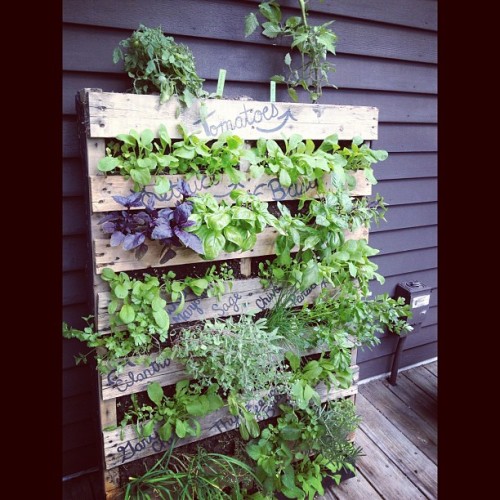 |
| As seen on Pinterest... |
Instead, my results looked like this-
DIRT EVERYWHERE!
So I went back to the drawing board and decided to recycle the crates I had found. I originally had a different project in mind for them, but they seemed like a good "container" for my plants.
All I did was put a large black trash bag in the crate, throw in a bunch of potting soil, and transplant the plants into them. I knew the dirt would slide out of the crate if I didn't line it with the bag, hence the trash bag.
This is where I faced my first interesting challenge. The roots of my seedlings had all started to intermingle and intertwine with each other. This was a problem. I was afraid that if I pulled them apart I would kill too much of the root system and kill my plants. (I was okay with a few of them dying, but I didn't want to kill ALL of them!) With little other choice, I kept them in little groupings, and planted them that way.
Meanwhile, in the front yard I did some homemade ghetto "topsy turvy" planting. I got 2 buckets from Home Depot, punched out a hole in the bottoms, and made my own topsy turvy planters. In these buckets I planted actual store-bought seedlings, and not seedlings I grew from seed.
The trees in my yard are ridiculously tall. We're talking redwoods tall. The lowest branches are still way above my head. I tried buying a shepard's crook to hang them from, but they just bent right over and fell. So I spray-painted my buckets green to help them blend in, and hung them on a dead dogwood tree right by my front door.
In one I have strawberries on the top and bottom.
In the other I have green peppers on top, and tomatoes on the bottom.
All of these plants are doing quite well. I've already had 2 strawberries out of the topsy turvy. (Another thing about living on top of a mountain- I've learned I have to wait longer for things to grow. All of our plants seem to be a good 2 weeks behind in growth what I see happening in yards in the valley.) And today I was very excited to see that I FINALLY have buds coming in on both the tomato plant and the green peppers.
Now back to my containers on the back deck. I haven't mentioned that yet, have I? In order to keep my plants safe from the raccoons, deer, etc., I am growing them all on the back deck. Except for the sunflowers- I planted those safely in the ground, way down in the backyard, in a very sunny spot. However, all 10 plants appear to have died. One of these days maybe I will hike down the backyard to inspect them. But they should have grown to at least 2 feet tall by now, and I can't see them, so I assume they didn't make it.
My crate containers have turned out really well! Natural selection has thinned the herd some, but I still have several very strong plants (more than I know what to do with). If it is true that one tomato plant can yield about 10 tomatoes a piece, I'm in for a bumper crop of tomatoes soon! I may only have 6 (7 if you include the bucket in the front yard), containers, but each one holds 2-4 plants each. There are easily 20 very strong tomato plants growing, and a weaker 10 additional plants.
Today I finally spotted several little buds popping up on the tomatoes, which is reassuring. I was starting to worry I was growing some very strong weeds!
The snow peas are a different story. I admit, I had no idea what I was getting into with these! I bought the seeds because they were less than a dollar. That was about the extent of my forethought. Little did I know that these plants can grow to be about the size of tomato plants! Mine are certainly not that big yet, but they are getting quite long and thick. This past weekend I started a new container, separated a few of the plants, and gave them some more room to grow. (The snow peas had the same problem as the tomatoes- the roots were completely intertwined.)
Which brings me to my pepper plants. Oh those fickle little plants! Out of a good 30 seedlings (from seed), I have maybe 3 still growing. They are getting strong and healthy, and are showing a few buds as well.
As you can see, they are not in crates. I saw this big green bag at a local nursery and bought it. It was about $30. It has worked out very well for me, however, it has not worked any better than the free crates. Also, it took two very large bags of potting soil to fill it up. It is now so heavy I can't lift it. I will continue to use the bag in the future, but I wouldn't recommend buying one. There is a mix of green peppers (store bought seedling), banana peppers, and jalapenos growing in there. To be honest, I'm not even sure if those are my jalapenos that I started from seed. All of the pepper plants look the same to me. (and my markers fell out) I will just have to be surprised when they finally grow in.
Here are my plants 2 weeks ago-
And my plants yesterday!
Pin It
Thursday, December 15, 2011
DIY Homemade and Affordable Dishwasher Detergent
 |
| DIY Homemade Dishwasher Detergent Ingredients |
In my never ending quest to find more affordable and greener alternatives to brand name products I recently started searching out better dishwasher detergents. Using Pinterest and Google I looked up several different homemade options for dishwasher detergents. The majority of them were very similar in ingredients and combinations. So I tested out a few options and here is what I came up with!
First, let's make sure you have optimal dishwasher conditions. Clean up your sink, run some water down the garbage disposal, and then put in 1 cup of bleach. Let the bleach sit for a few minutes before running hot water and the garbage disposal. This will get the muck out of your system, and help your dishwasher run better.
Second, do the same with your dishwasher. Empty the dishwasher, pour 1 cup of bleach in the bottom of your dishwasher, and run a short, hot cycle. This kills any lingering bacteria in your dishwasher, and cleans out the muck in the pipes. I frequently toss my sponges in the dishwasher (top rack) when I do this.
Now, knowing your system is at its best, here's the cheapest, and incredibly effective homemade, dishwasher detergent!
DIY Dishwasher Detergent Ingredients-
1 box Borax (4lbs 12 oz or 76 oz ) (I found it by the laundry detergent) $5.15
1 box Arm and Hammer Baking Soda (2 lbs box) $3.59
White Vinegar $1.19
Mix the Borax and baking soda in a bowl, and store in a dry container. And that's it! Ta da! No fancy anything to it! All you need is 1 tablespoon of the dry mixture! Put it in the detergent dispenser of your dishwasher.
The vinegar is in lieu of other rinse aids. Fill up your rinse aid dispenser with the vinegar.
The ingredients at full cost only come to $9.93. But because I'm always looking for ways to make things even more affordable, I went to ArmandHammer.com and got some coupons! I got a full dollar off the baking soda, and when I got to the store it was on-sale $0.75 off! Woo-hoo! Bargain!
This detergent 'recipe' makes about a 6 month supply! Math- 76 oz + 64 oz = 140 oz. 1 tablespoon = .5 ounces. Which comes to 280 "servings." If you do 1 load a day, that's 280 days, which is closer to 9 months. But you may want to use just a touch more for heavy loads, and sometimes you may do 2 loads a day. So we'll compromise and say it is a 7.5 month supply of dish detergent for under $10 (or $8 if you use the coupon)!
It's cheap, but DOES IT WORK?!
Before-


Other versions included adding citric acid, kosher salt, or epsom salts. One even said to add lemon rinse. None of these products add to the effectiveness of cleaning, so I don't see the point in using them. (I really don't get the point of the salt!) If you have hard water you may want to add the lemon rinse (which was not cheap) to get shinier glass. I have really hard water, but this method worked just fine for me!
Pin It
Wednesday, October 12, 2011
A green way to pushing up daisies
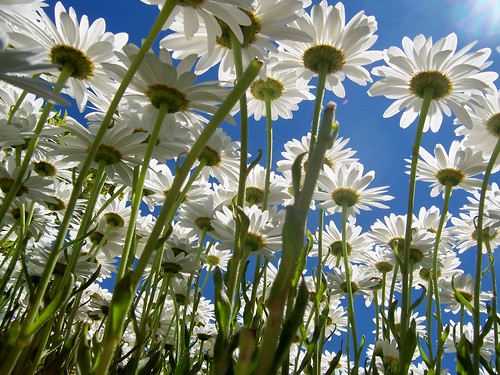
Have you ever contemplated your own funeral, picked out your own casket, weighed your cremation options, and wondered who and how it is going to be paid for? "Green funerals" are becoming more popular. From foregoing embalming fluids (all those chemicals aren't good for the soil), compostable urns, and pine boxes, there are a more than a few ways to leave your mortal corpse behind.
Check out Bury Me Green.
Thursday, September 1, 2011
Tuesday, August 30, 2011
Make your home eco-friendly
Tips on "green mortgages," green living, and making your home healthier!
Monday, May 30, 2011
Green Summer Entertaining
Looking for some eco-friendly summer entertaining ideas? Check out the iVillage suggestion here-
Green Summer Entertaining
From bamboo skewers to faux bonfires, this list is full of ideas!
Green Summer Entertaining
From bamboo skewers to faux bonfires, this list is full of ideas!
Saturday, April 30, 2011
El Hierro to become first self-sustaining inhabited landmass

The Spanish island of El Hierro (nicknamed the "Meridian Island") intends to become the first inhabited landmass that is completely energy self-sufficient. El Hierro will be combining the two abundant resources that will never abate, regardless of weather, to create energy.
Located 750 miles off the coast of the Spanish mainland (the easternmost point of the Canary Islands), El Hierro is a mountainous, volcanic island with no coal or fossil fuels. Currently, fresh water and diesel are brought in weekly by tanker. But by the end of 2011 their dependence on outside fuel sources will come to an end as an innovative wind-power system goes online.
"At first, it was simply an issue of becoming more self-sufficient," says Tomas PadrÓn, president of the Island Council, whose role is similar to that of a mayor's. "We were completely dependent on outside deliveries and could be cut off at a moment's notice. But then with the global-energy crisis, and climate change, and everything else that's happened, we've realized it has a lot more value."
At the moment, the project looks more like a hole in the ground than a self-sustaining island. Or two holes, to be exact: one on top of a mountain, another smaller one down below, and in between, a long stretch of pipeline tinted the same color as the local scrub.
Five windmills on the northeastern end of the island will power a pumping station that, when the wind is blowing, will drive water 2,300 feet uphill, from a small, 5 million-cubic-foot reservoir down by the shore to a larger, 19 million-cubic-foot reservoir tucked into one of the island's volcanic craters. When the wind is not as abundant, water from the top depository will be released, along 1.8 miles of mostly camouflaged pipes, into the bottom one, and the pressure of that falling water will drive six hydraulic turbines.
"If we don't want to depend on fossil fuel, we have to have steady input and output," says Gonzalo Piernavieja, director of research and development for the Technological Institute of the Canaries, which designed the plant. "And the only way to do that is through massive storage. In this case, we're using nature's gifts, wind and sea water, for storage."
The plant will produce 48 GW/h (gigawatt hours), enabling the island to conserve some 6,000 tons of diesel per year, and to meet 100% of its energy needs by 2015. And by that time, the island will be well into its next sustainability projects. One of them, already underway, is a plan convert all 4,500 of El Hierro's cars to electric; the same municipal company, Gorona del Viento, that is building the new hydroeolic station will supply car batteries powered by excess energy from the plant. "The whole system will be integrated," says Javier Morales, El Hierro's councilman for sustainability. "It's beyond green. When the power plant and the car system interact, it will be like galaxies colliding."
Unlike most of the Canary Island economies which depend on tourism, El Hierro remains largely dependant on its primary exports of pineapples and mangoes. The farmers are also looking to become more “green-friendly.” The island's agricultural cooperatives have signed a plan to convert their fields to organic production over the next eight years. They will be connected to a "biodigester" that converts sewage into both methane (which can then be used as fuel) and fertilizer.
But if El Hierro's problems are particular, its solutions don't have to be, say officials. "Absolutely this technology can be applied elsewhere," says Morales about the power station, whose upper reservoir is currently being lined with massive sheets of PVC in preparation for the first water pumping. "Hawaii, for example. We're already advising them." That's something that another volcanic archipelago, notably larger but perhaps newly aware of the limits of conventional energy, might want to look into.
Monday, April 25, 2011
5 Green Jobs Saving the Planet

The US Green Building Council, a non-profit group that promotes eco-friendly building practices, suggests that green-friendly construction projects will add $7.9M green jobs and $554B to the American economy over the next 2 years. The US federal government included $750M in green job training in the American Recovery and Reinvestment Act (ARRA) of February 2009 that will make these green jobs possible. As a result, the next big surge in jobs will be in green sectors technology.
#1- Home Energy Auditor
These professionals will usually have a professional history in residential home construction. They evaluate homes for what kind of improvements will increase home energy efficiency.
#2 Green Teacher
As industries become more aware of green opportunities, the need for teachers to train others about green technology is growing. These teachers are not trained education professionals, but individuals with a background in interior design and architecture. To get involved in these types of jobs it is important to become Leadership in Energy and Environmental Design (LEED) certified. LEED is a green building standard that certifies a building was constructed using environmentally friendly techniques.
Information on LEED certifications and exams can be found on the US Green Building Council website.
#3 Green Engineer
Civil and mechanical engineers with LEED certifications that can consult on green building projects are in demand. They assist in determining water runoff design systems, cooling and ventilation systems, and other sustainable engineering efforts.
#4 Wind Power Salesperson
As homeowners begin to take advantage of the IRS renewable energy systems tax credits, sales for green items like wind turbines are going up! Salespeople can take advantage of this by getting on top of the next big thing and get jobs selling now.
#5 Weatherization Expert
These experts work with homeowners to improve and retrofit their homes with new windows, insulation and other product to improve their home energy efficiency. ARRA provided as much as $5B for residential weatherization improvement projects. According to the National Association of Home Builders the lack of skilled weatherization experts make this a potentially lucrative field.
Source: Fox Business
Friday, April 22, 2011
Happy Good Friday, Earth!
Happy Earth Day, everyone!
I love that this year Earth Day and Good Friday fall together. Good Friday was the day Jesus Christ was crucified. The day He died for our sins. Three days later He rose again, making the world anew. It many ways it feels appropriate to honor Him but celebrating Earth Day as well.
It is the day we can plant the seeds, so that the earth can renew itself. If Christ had not done what was required of Him to save us, He could not have been resurrected. If we do not do what is required of us to save our planet, it will not be resurrected.
I love the symmetry of these two days together! What a wonderful way to honor the gifts of the Earth that the Lord has given us. What a wonderful way to show our gratitude for all that we have been given, by giving back and respecting God's creations.
Check out EarthDay.org for a Billion Acts of Green and local events.
Christian Science Monitor talks about how to fix environmental education.
Celebrate Earth by enjoying these amazing pictures taken by NASA
Take a look at the Fox Network "Green It. Mean It." campaign videos.
Pastor Craig Goodwin asks CNN: Are Earth Day and Good Friday an Unholy Alliance? (He takes a minute to get there, but his answer may surprise you.)
If there is any doubt in your mind about showing thanks for God's Creations on Earth Day, I offer you the Mormon Tabernacle Choir singing, "For the Beauty of the Earth"
I love that this year Earth Day and Good Friday fall together. Good Friday was the day Jesus Christ was crucified. The day He died for our sins. Three days later He rose again, making the world anew. It many ways it feels appropriate to honor Him but celebrating Earth Day as well.
It is the day we can plant the seeds, so that the earth can renew itself. If Christ had not done what was required of Him to save us, He could not have been resurrected. If we do not do what is required of us to save our planet, it will not be resurrected.
I love the symmetry of these two days together! What a wonderful way to honor the gifts of the Earth that the Lord has given us. What a wonderful way to show our gratitude for all that we have been given, by giving back and respecting God's creations.
Check out EarthDay.org for a Billion Acts of Green and local events.
Christian Science Monitor talks about how to fix environmental education.
Celebrate Earth by enjoying these amazing pictures taken by NASA
Take a look at the Fox Network "Green It. Mean It." campaign videos.
Pastor Craig Goodwin asks CNN: Are Earth Day and Good Friday an Unholy Alliance? (He takes a minute to get there, but his answer may surprise you.)
If there is any doubt in your mind about showing thanks for God's Creations on Earth Day, I offer you the Mormon Tabernacle Choir singing, "For the Beauty of the Earth"
Monday, April 18, 2011
Healthy living comes to college campus
A "healthy living" dorm has come to Johns Hopkins University in Baltimore, MD, where students are growing their own vegetables and herbs.
Check out the full story at A healthy-living dorm at Johns Hopkins on Washingtonpost.com
Check out the full story at A healthy-living dorm at Johns Hopkins on Washingtonpost.com
Friday, April 15, 2011
Tuesday, February 1, 2011
Green Weddings and Events
Looking to plan a wedding or formal event? Check out these great blogs!
Dream Green Wedding Blog
Eco-Beautiful Weddings
Earth Friendly Weddings
Dream Green Wedding Blog
Eco-Beautiful Weddings
Earth Friendly Weddings
Sunday, January 30, 2011
Green Starter Homes

More builders are offering green homes that won’t send you into bankruptcy or catapult you completely out of the mainstream. The following are just some of the available choices — including prefab, modular and sustainable subdivisions — for folks who want green but don’t have a lot of it to spend.
Read the rest at 7 affordable green starter homes on the Mother Nature Network
Subscribe to:
Posts (Atom)
