Pages

Showing posts with label going green. Show all posts

Thursday, October 8, 2015

10 Uses for Vinegar


Ten Great Ways to Clean With Vinegar
  1. Remove crayon marks from clothes with a few dabs of vinegar.
  2. Remove stickers and price tags by dabbing a little vinegar on the sticker.
  3. Disinfect cutting boards by wiping it down with vinegar after every use.
  4. Wash away mildew from your shower curtain by spraying vinegar on it after you bathe.. 
  5. Remove stains from pots and pans by mixing 1 cup vinegar 2 tbs baking soda 1 cup water.
  6. Peel off wallpaper by mixing equal parts of water and vinegar and spraying directly onto the wallpaper.
  7. Clean and disinfect baby toys. Then rinse them well so babies don't taste it when they put them in their mouths.
  8. Fabric softener by adding about 1/4 cup of vinegar to your laundry load to soften your fabric.
  9. Gum remover — spray vinegar on the area where the gum is stuck & the gum will dissolve.
  10. Get shinier, streak-free glasses by adding a cup of vinegar to your dishwasher with each load.

Wednesday, June 26, 2013

Pinching Off Tomato Suckers- an Analogy for Life


This morning while working in my (container) garden, a life lesson hit me in the form of a gardening analogy. (I suddenly understand why the scriptures are full of so many gardening analogies.)

I'm growing a berzillion tomato plants (in containers) on my deck. (A post on just container gardening coming soon.) If you have ever grown tomatoes you know you have to pick off the suckers. This is my first ever attempt at any sort of gardening (with the exception of putting a blueberry bush in the ground last year and telling it to fend for itself). The concept of picking off the suckers was foreign to me. I heard about it from several people, and even watched a YouTube video ("Pinching out" your growing tomato plants) on it, before I finally gave in and tried it.

I'll be honest, the idea of breaking off what appeared to be perfectly good piece of the plant did not seem reasonable to me. It didn't matter that everyone kept telling me that by pinching or picking off the "suckers" that the rest of the plant would flourish. Many of the "suckers" already had blooms on them, and appeared to be putting out good fruit. Why would I want to cut those off?

If you have never done it before, here are some pictures.
On a tomato plant you have the main stem, and then branches. A "sucker" is the little branch that grows out between the stem and the branch (making it a tripod, in a way).

It is hard to see the sucker in the picture above until you get more familiar with the concept. If anything, the picture above looks like a healthy, blooming, fruit bearing branch. 

But if you look closer, it is easy to see the sucker. It's that little branch my finger is pointing at, that grows out of the middle.
But if you look closely, you can see it has potential to be a fruit-bearing stalk. It's furry and has the right kind of leaves. It can be really hard to convince yourself to pinch that stalk or stem off.
 Why do you pinch the suckers off? What's the point?
Well, the general idea is that they 'suck' the energy from the more important branches. You want the plant to be sending all of its goodness to the right place. And the more suckers you have, the more the energy gets sucked up. The suckers can put out good fruit. You can leave them there. But the fruit you get won't be as good. It's a choice between quality and quantity. Do you want really good tomatoes? Nice, big round ones? Or just a lot of them? That's the choice you have to make. Quality v. quantity.
 Your suckers can even have suckers. The picture above is a great example of suckers within suckers.
If you aren't familiar with tomato gardening, it can be hard to recognize what a good stem or branch looks like. You want your fruit or blooms to be coming off the branch like in the picture above. When you see a good branch, it is easy to tell. But they are often hiding beneath all of the suckers. Here is the first picture I showed you. Did you even notice the good fruit? Or did you only see the sucker branches?


Here is the life lesson or analogy I picked up along the way today-
Our time, energy, and efforts, are often split and divided in a dozen different directions or branches. Some of the branches are good, some just appear to be good, and some are time sucks that are easy to spot.
But sometimes it can be hard to cut the suckers out of our lives. They can put out fruit, and be hard to cut out. Why would you want to cut something out that produces something good? Even when you know having more time and energy to put into the truly good things would be good for you, and make things grow and flourish, it can be really hard to do.
It can also be hard to identify which things you need to cut out. And you'll find yourself justifying not cutting out some of the suckers, because they do put out good results.
This sucker is so big and strong that it was hard to convince myself to cut it off. It already had blooms on it. But I could see the healthy, good blooms right above it. I knew if I removed the sucker (no matter how big and healthy it appeared), the blooms would benefit from it.

It's all a choice.
I do know this much-
I picked off dozens of suckers a few days ago off of my plants. Just 3 days later my plants have grown tremendously in size, and more of the good blooms have really gotten bigger and healthier.
After I witnessed the improvement in my plants after trimming off the suckers, I got the courage to cut off even more of the suckers - the ones I had left on the plants because they looked so big and healthy, and were putting out fruit already.
I don't feel guilty about it anymore. In fact, I'm excited to see how much more improvement my tomatoes will make. They should all be coming in and ready to harvest in about 2-3 more weeks. (It would have been 3-4 more weeks if I had left the suckers on.)


Pin It

Monday, June 24, 2013

Container Gardening by a Rookie

I finally live in a place where I can do some actual gardening. Or, at least it appears to be the kind of place you could do some gardening. But it's all a lie.
I live on top of a mountain, with a large yard and plenty of land.  Each of my neighbors have plenty of land as well. We can't see each other, and we all like it that way.
So what's the problem?
Nature. All that dang nature. It comes with a catch.

My next door neighbor's view

It starts with "on top of a mountain." Our yard is extremely steep. So steep in fact that there is no reasonable way to put a vegetable (or flower) garden in the backyard. And try as I may, there just isn't a good spot in the front yard for a vegetable garden either.
What space I do have in the front yard is a magnet for raccoon and deer. (Not to mention a very passive and friendly bear that lives in the woods between my house and the next house over.)
And so I have resorted to container gardening, greatly aided by ideas garnered on Pinterest.
About 8 weeks ago I bought a starter kit and planted several seeds- tomatoes, jalapenos, snow peas, and sunflowers. I followed the directions, and planted "2-3 seeds per disk." This is something of a joke to me now. It said that because many of the seeds will not take, that it is important to plant 2-3 seeds. I planted 15 disks of each type of plant.

As luck would have it, ALL of the tomatoes took! Not 15 of them! 45! 45 tomato plants! Heaven help me!
Naturally only about 2-4 of the jalapenos actually worked. ALL of the sunflowers (roughly 30) took. And a good 20 of the snow pea plants grew.
That was a problem. I did not have the time nor space nor money to buy that many containers! So I got inventive. (This is where Pinterest (http://pinterest.com/erinannie/gardening/) came in handy.)
Oh wait, I almost forgot to tell you the funny part of this story! Back in early April I hired a teenage boy to come over and do some yard work and clean up for me. He found a topsy turvy I attempted to grow some tomatoes in last year, (It never worked.), some old potting soil, and a bag of seeds. I told him to just toss it all in the topsy turvy, and totally forgot about it. A few weeks later I came back to find a good 20-30 tomato seedlings growing! OOPS!
So there I was with a potential 80 tomato plants, and dozens of other plants needing a bigger home.
I read up on vertical pallet gardening and originally thought that would work perfectly for me. What resulted was just wrong, and pretty funny if you had been there to witness it.
After some diligent dumpster diving for a pallet, I found 2 that I thought might work. (I also just happened to find several really sturdy grocery crates and nabbed them too.)
The instructions seemed simple enough, and the final product was supposed to look like this-
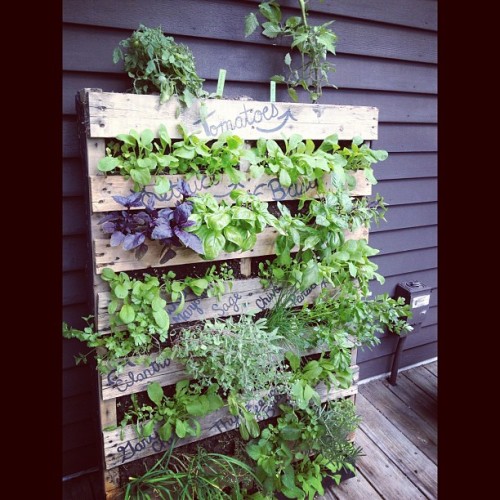
As seen on Pinterest...

Instead, my results looked like this-

DIRT EVERYWHERE!


So I went back to the drawing board and decided to recycle the crates I had found. I originally had a different project in mind for them, but they seemed like a good "container" for my plants.


All I did was put a large black trash bag in the crate, throw in a bunch of potting soil, and transplant the plants into them. I knew the dirt would slide out of the crate if I didn't line it with the bag, hence the trash bag.

This is where I faced my first interesting challenge. The roots of my seedlings had all started to intermingle and intertwine with each other. This was a problem. I was afraid that if I pulled them apart I would kill too much of the root system and kill my plants. (I was okay with a few of them dying, but I didn't want to kill ALL of them!) With little other choice, I kept them in little groupings, and planted them that way.

Meanwhile, in the front yard I did some homemade ghetto "topsy turvy" planting. I got 2 buckets from Home Depot, punched out a hole in the bottoms, and made my own topsy turvy planters. In these buckets I planted actual store-bought seedlings, and not seedlings I grew from seed.

The trees in my yard are ridiculously tall. We're talking redwoods tall. The lowest branches are still way above my head. I tried buying a shepard's crook to hang them from, but they just bent right over and fell. So I spray-painted my buckets green to help them blend in, and hung them on a dead dogwood tree right by my front door.

In one I have strawberries on the top and bottom.


In the other I have green peppers on top, and tomatoes on the bottom.


All of these plants are doing quite well. I've already had 2 strawberries out of the topsy turvy. (Another thing about living on top of a mountain- I've learned I have to wait longer for things to grow. All of our plants seem to be a good 2 weeks behind in growth what I see happening in yards in the valley.) And today I was very excited to see that I FINALLY have buds coming in on both the tomato plant and the green peppers.


Now back to my containers on the back deck. I haven't mentioned that yet, have I? In order to keep my plants safe from the raccoons, deer, etc., I am growing them all on the back deck. Except for the sunflowers- I planted those safely in the ground, way down in the backyard, in a very sunny spot. However, all 10 plants appear to have died. One of these days maybe I will hike down the backyard to inspect them. But they should have grown to at least 2 feet tall by now, and I can't see them, so I assume they didn't make it.

My crate containers have turned out really well! Natural selection has thinned the herd some, but I still have several very strong plants (more than I know what to do with). If it is true that one tomato plant can yield about 10 tomatoes a piece, I'm in for a bumper crop of tomatoes soon! I may only have 6 (7 if you include the bucket in the front yard), containers, but each one holds 2-4 plants each. There are easily 20 very strong tomato plants growing, and a weaker 10 additional plants.

Today I finally spotted several little buds popping up on the tomatoes, which is reassuring. I was starting to worry I was growing some very strong weeds!

The snow peas are a different story. I admit, I had no idea what I was getting into with these! I bought the seeds because they were less than a dollar. That was about the extent of my forethought. Little did I know that these plants can grow to be about the size of tomato plants! Mine are certainly not that big yet, but they are getting quite long and thick. This past weekend I started a new container, separated a few of the plants, and gave them some more room to grow. (The snow peas had the same problem as the tomatoes- the roots were completely intertwined.)

Which brings me to my pepper plants. Oh those fickle little plants! Out of a good 30 seedlings (from seed), I have maybe 3 still growing. They are getting strong and healthy, and are showing a few buds as well.

As you can see,  they are not in crates. I saw this big green bag at a local nursery and bought it. It was about $30. It has worked out very well for me, however, it has not worked any better than the free crates. Also, it took two very large bags of potting soil to fill it up. It is now so heavy I can't lift it. I will continue to use the bag in the future, but I wouldn't recommend buying one. There is a mix of green peppers (store bought seedling), banana peppers, and jalapenos growing in there. To be honest, I'm not even sure if those are my jalapenos that I started from seed. All of the pepper plants look the same to me. (and my markers fell out) I will just have to be surprised when they finally grow in.

Here are my plants 2 weeks ago-

And my plants yesterday!
I'd say my container gardening experiment is working out just fine!

Pin It

Friday, November 23, 2012

Turn Black Friday GREEN

REPRINTED FROM THE WASHINGTON POST "AFTER THANKSGIVING, TURN BLACK FRIDAY GREEN"

Thanksgiving has so much going for it. Here we are at a big table with our family, expressing gratitude for the food we’ve put on it. We love the fellowship, the cooking, the eating and the celebration of indigenous fare such as turkey, cranberries and pumpkins. For those who don’t have to work on Friday, it’s a mini-vacation of four days! At least it used to be. Now we have Black Friday.
At sunup the day after Thanksgiving, all that gemutlichkeit vanishes and shoppers rush out to beat one another to the first big pre-Christmas sales in a desperate, unfriendly mob. Try to find a link between this and any Christmas tradition. Maybe it’s the journey to Bethlehem to be tithed by the Romans, with millions of Marys and Josephs now summoned and stretched beyond their means by the corporate command to buy. For many, this year will be black indeed.
There’s nothing wrong with gift-giving, but finding more affordable, sustainable and economical ways to do it will make Christmas merrier.
First, it’s more satisfying to shop within the community. Gifts from independent stores, especially when made by local artisans, support the local economy and seem more personal, too. My local bookseller always tips me off to what new titles the people on my list would like and might not have read. A meal at a special restaurant (good cheer around the table, again!) might be well received. In fact, any gift that is experienced or quickly consumed rather than stored has a double benefit. Most of us have little extra space for stuff.
Homemade gifts are always meaningful, whether hand-knit or home-grown. Okay, not everyone dreams of finding a kohlrabi under their tree. But many would love a basket of your garden’s (or your root cellar’s) finest on a holiday when many must be fed. Or spread it out over the season with a pie-of-the-month club. Give a membership in a local CSA (Community Supported Agriculture) farm. No assembly required, no batteries included.
You might jump-start a would-be gardener by building her a compost bin, or having a truckload of well-rotted manure delivered to her yard. Give something that takes advantage of nature’s own economics, a system in which all living things are recycled. As the Greek philosopher Anaximander put it, “Everything that forms in nature incurs a debt which it must repay by dissolving so that other things may form.”
Read the rest on the WashingtonPost.com. 

Wednesday, October 19, 2011

10 Green Dating Ideas


Volunteer Together! Spend time learning and talking about causes or issues that are most important to you and your date/mate. You both are most likely to be inspired, turned on, and energized, by volunteering for something you believe in. For example, look in your neighborhood newspaper together and find out when local organizations are doing habitat restoration projects, feeding the homeless or having a fundraising dinner for the local environmental agency. Start locally and as the relationship evolves, you can expand your volunteering together, nationally or globally.  


Plan a green camping trip. Leave the city, phones, computers, ipods behind, and embrace nature. Quiet time spent in the woods promotes deep conversation and getting to know one another.   Don’t use plastic or paper throw-away products and do dishes together out of a sudsy bucket using green, biodegradable dishwashing soap. Play a game of sexy strip poker by candle light. Try some constellation identification and bring a musical instrument to play at night (even if you don’t know how to play!).  

Thursday, October 13, 2011

Urban Beekeeping


urban beekeeping

The Architecture Foundation (AF) launched an international competition this week to design urban beehives. 

Over the past two years the world's bee population has dwindled. Bees play a vital role in pollinating both wild and farmed plants. According to Kate Canning of the Twickenham and Thames Valley Bee Association says that bee-keeping has increased in popularity amongst young urbanites. 

Wednesday, October 12, 2011

A green way to pushing up daisies

pushing up daisies

Have you ever contemplated your own funeral, picked out your own casket, weighed your cremation options, and wondered who and how it is going to be paid for? "Green funerals" are becoming more popular. From foregoing embalming fluids (all those chemicals aren't good for the soil), compostable urns, and pine boxes, there are a more than a few ways to leave your mortal corpse behind.

Check out Bury Me Green.

Friday, July 1, 2011

Click to Help the Hunger Site!

Have you heard about the Hunger Site?
The Hunger Site provides simple, effective, feel-good ways to address an urgent, specific humanitarian need: the eradication of world hunger. Since its launch in June 1999, the site has established itself as a leader in online activism, helping to feed the world's hungry and food insecure. On average, over 220,000 individuals from around the world visit the site each day to click the yellow "Click Here to Give - it's FREE" button. Since its inception, visitors at The Hunger Site and shoppers at The Hunger Site store have given more than 671 million cups of food.


The staple food funded by clicks at The Hunger Site is paid for by site sponsors and distributed to those in need by Mercy Corps, Feeding America (formerly America's Second Harvest), and Millennium Promise. 100% of sponsor advertising fees goes to our charitable partners. Funds are split between these organizations and go to the aid of hungry people in over 74 countries, including those in Africa, Asia, Eastern Europe, the Middle East, Latin America and North America.

By clicking the icon above you will be taken to the Hunger Site, where just your click on the big yellow button on their site makes a difference!! You can also shop around the site, clicking on their sponsors, knowing that your clicks will also help feed the hungry!

So what are you waiting for? CLICK CLICK CLICK!!

Friday, June 24, 2011

Salmonella and Norovirus- where is it hiding in your kitchen?

salmonella
Salmonella

Think that cantaloupe you are eating is safe and healthy? Think you can't get salmonella from fruits and vegetables grown in your own back yard?
Wrong! 
Check out this news story on the 10 Dirtiest Foods You're Eating!
And then go wash your hands, your sponge, your table, and more! Because, eww! Gross!

Tuesday, June 21, 2011

Going Green and Saving Green??


If you think living an eco-friendly lifestyle will be as good for your pocketbook as it is for the planet, you may be in for a rude awakening. Although there are many ways the going green can save you money, many ‘green’ alternatives will actually cost you more money. 
Check out this article on "10 Reasons Going Green Can Cost You More Green." 

Monday, April 25, 2011

5 Green Jobs Saving the Planet

green jobs

The US Green Building Council, a non-profit group that promotes eco-friendly building practices, suggests that green-friendly construction projects will add $7.9M green jobs and $554B to the American economy over the next 2 years. The US federal government included $750M in green job training in the American Recovery and Reinvestment Act (ARRA) of February 2009 that will make these green jobs possible. As a result, the next big surge in jobs will be in green sectors technology.

#1- Home Energy Auditor
These professionals will usually have a professional history in residential home construction. They evaluate homes for what kind of improvements will increase home energy efficiency.

#2 Green Teacher
As industries become more aware of green opportunities, the need for teachers to train others about green technology is growing. These teachers are not trained education professionals, but individuals with a background in interior design and architecture. To get involved in these types of jobs it is important to become Leadership in Energy and Environmental Design (LEED) certified. LEED is a green building standard that certifies a building was constructed using environmentally friendly techniques.
Information on LEED certifications and exams can be found on the US Green Building Council website.

#3 Green Engineer
Civil and mechanical engineers with LEED certifications that can consult on green building projects are in demand. They assist in determining water runoff design systems, cooling and ventilation systems, and other sustainable engineering efforts.

#4 Wind Power Salesperson
As homeowners begin to take advantage of the IRS renewable energy systems tax credits, sales for green items like wind turbines are going up! Salespeople can take advantage of this by getting on top of the next big thing and get jobs selling now.

#5 Weatherization Expert
These experts work with homeowners to improve and retrofit their homes with new windows, insulation and other product to improve their home energy efficiency. ARRA provided as much as $5B for residential weatherization improvement projects. According to the National Association of Home Builders the lack of skilled weatherization experts make this a potentially lucrative field.

Source: Fox Business

Friday, April 15, 2011

Saturday, April 9, 2011

Eco-farming could double food production

A UN Report says that food production in developing countries could double, if farmers move away from chemical fertilizers and pesticides.
Among examples given for moving to eco-farming include insect-trapping plants in Kenya, and ducks that eat weeds in Bangladeshi rice paddies. 
"Agriculture is at a crossroads," says the study by Olivier de Schutter, the UN special reporter on the right to food, in an effort to lower high food prices and avoid the costly oil-dependent model of industrial farming.
According to the report, eco-farming projects in 57 nations showed an average crop yield gains of 80%  by tapping natural methods for enhancing soil and protecting against pests.
It is suggested that "agro-ecology" could make farms more resilient to extreme weather conditions, including floods, droughts and a rise in sea levels.
Benefits would be greatest in "regions where too few efforts have been put in to agriculture, particularly sub-Saharan Africa," he said. "There are also a number of very promising experiences in parts of Latin America and parts of Asia.
Examples of successful "agro-ecology" in Africa include the thousands of Kenyan farmers who planted insect-repelling desmodium or tick clover, used as animal fodder, within corn fields to keep damaging insects away and sowed small plots of napier grass nearby that excretes a sticky gum to trap pests.
For the full story visit commondreams.org

Friday, April 8, 2011

Sustainable living guru's guide to life


Jeffrey Hollender, co-founder of the environmentally friendly and socially responsible household products company, Seventh Generation has published a new book, "Planet Home: Conscious Choices for Cleaning and Greening the World You Care About Most
His book calls readers to adapt a higher consciousness about sustainable living. 
 “What you do at home can impact the world around you, and the world around you can impact what you do at home.”

Read more about Hollender and his new book in the Washington Post wellness and lifestyle section.


Thursday, March 10, 2011

Searching for profits and saving Patagonia

In a white two-story house near the beach waits Warren Adams, a 44-year-old American entrepreneur and the co-founder and CEO of Patagonia Sur. With his small, four-year-old for-profit company, Adams is conducting an experiment that could radically change the way land is developed, using a formula that applies the forces of the free market to generate jobs and wealth and at the same time preserve millions of acres for future generations.


Read the rest at Searching for Profits and Saving Patagonia

Wednesday, March 2, 2011

SunChips Compostable Bag

Who doesn't love the tastiness of SunChips? Oh those lovely, flavorful, healthier than average, snack chips! Personally, I love the Harvest Cheddar.
SunChips recently introduced a new compostable bag to protect and house their tasty little chips. But there was a little problem.
THEY ARE WAY TOO LOUD.
Example:


You can't sneak these babies into the back of a classroom, or munch at work, with these bags! You could wake the living dead with these bags.

So SunChips to the rescue again.
Less than six months after pulling the original (NOISY) compostable bags due to complaints, SunChips announced today that it has created a new, quieter, version
The move last fall to withdraw the green plant-based packaging from all flavor of chips except original, drew both praise and scorn. After all, it had only been 18 months since the company had championed its new eco-friendly bags - the first of its kind that could be broken down in an active compost bin in as little as 14 weeks.
The move disappointed environmentalists, with many upset that SunChips would so quickly abandon its sustainability goals over fragile ears.
According to the AP, the company found that by changing the razor-thin adhesive used in separating the inside of the bag from the outside with all the logos and other information, it created a kind of noise barrier.
That new discovery led to the decibel levels of the packaging going from 80-85 decibels to just around 70 decibels - or the noise level of a standard chip bag.
The new compostable bags are making their way into stores but will only be available in original flavor for now. Understandably, SunChips is waiting to hear whether any critical noise is generated before rolling out the new packaging to the rest of its product line.


Warren Buffet Hearts Wind Energy

Money mogul, business man, smart guy, and philanthropist Warren Buffett loves wind energy. And not surprisingly, he owns the #1 wind utility in the United States.
Buffett holding company, Berkshire Hathaway, has made significant investments in wind power. From the annual shareholder letter- 
MidAmerican will have 2,909 megawatts of wind generation in operation by the end of 2011, more than any other regulated electric utility in the country. The total amount that MidAmerican has invested or committed to wind is a staggering $5.4 billion. We can make this sort of investment because MidAmerican retains all of its earnings, unlike other utilities that generally pay out most of what they earn.


Source: Treehugger.com

Friday, February 25, 2011

Spring Cleaning the Green Way

It is just about that time of year again where the sun returns, energizing our bodies and homes, after a long, dull winter. Inevitably, the sun, warmth, and energy lead to a little spring cleaning.
Which household cleaners are best on the environment? Which have the most chemicals in them?
This article from the UK Telegraph answer all.

Green Spring Cleaning

Monday, February 21, 2011

Pollution in U.S. Drinking Water

How polluted is the U.S. drinking water?
U.S. tap water is some of the cleanest on Earth, generally safe from the microbes and chemicals that have plagued humans' water supplies for millennia. While much of the planet relies on paltry, polluted drinking water, Americans can fill a glass without fear of cryptosporidium, chromium or chlordane. 
Check out this interactive map from the Mother Nature Network here.

Monday, February 7, 2011

Eco friendly Valentine ideas

Are you looking for that perfect eco-friendly and economically friendly Valentine's Day gift?
Here are a few suggestions to help you on your way-


Eco Jewelry - for instance this beautiful vintage smoky pendant prism would make just about any girl happy!

Check out the Global Exchange Store for fair trade gifts, including chocolate, flowers, and diamonds. 

Consider staying at home and making an affordable organic meal, instead of eating out.

And before you buy your green Valentine flowers this year, make sure you get them from Organic Bouquet! Fair trade, no pesticides, and organically grown roses!

Fresh Eco-Elegant Valentines Day Flowers from $29.95 at OrganicBouquet.com!  125x125 banner

Related Posts Plugin for WordPress, Blogger...